

Short answer
This page addresses the question “centre mount vs rear mount kickstand” for Australian riders. It is not a product ranking; it is a check of fit, specification and failure mode for an adjustable 33–38cm alloy kickstand. It draws on 983 competitor reviews collected for this site and contains no independent bench testing, no security rating and no unverified rule or penalty figure.
Last verified: 2026-11-04 (AEDT). Specifications are listing transcriptions, not test results. Search volume and ranking data are not available for this page.
Key facts you can check
| Field | What we can state | How to check it |
|---|---|---|
| Subject | Adjustable Alloy Kickstand 33-38cm | Measure on your own bike |
| First check | The leg extends from 33cm to 38cm to suit different wheel sizes. | Listing specification, as at 2026-11-04 (AEDT) |
| Key measurable terms | 33-38cm, aluminium alloy, hex bolts, 27.5in | Tape measure, scales, or valve/wheel check |
| Typical situation | parking a loaded bike without leaning it on a wall | Your own parking time and location |
| Review sample | 983 competitor reviews | Corpus text match, not a defect rate |
| Independent testing | None on this page | We do not run a test programme |
Where we quote a review, the review id is printed beside it so the wording can be checked against the source corpus.
What problem are you actually solving
There is no shortage of opinion on centre mount vs rear mount kickstand. There is a shortage of checks a rider can actually repeat at home with a tape measure.
Specifications are written for a test bench or a listing page. Your bike, your rack and your commute are not the test bench.
A reported fault is a description, not a diagnosis. The same symptom can come from installation, wear or an unsuitable specification.
Here, fit means the measurable relationship between a part, a frame and a fixed object. It is not a matter of brand preference.
The three failure modes worth checking first
1. Fit and alignment
Note the valve or wheel size on your bike, then compare it with the compatibility line. Do this before the packaging is discarded.
The next section separates the measurable specification from the surrounding claims.
2. Mechanism and reset
Charge or cycle the device fully once, then test it again after a week. Several buyer reports describe a fault appearing in that interval.
Once the fit is settled, the remaining uncertainty is about behaviour over time rather than dimensions.
3. Wear after several weeks
Keep a short written record: the date, the measured dimension, and what happened on the tenth cycle. It makes a return conversation simple.
The distinction is worth one more step, because it changes what you should test on delivery.
Buying the strongest item and leaving it at home is a common outcome. Portability belongs in the decision, not as an afterthought.
Specifications that matter
Read the dimensions before the adjectives. 33-38cm and aluminium alloy can be measured; claims about overall strength usually cannot.
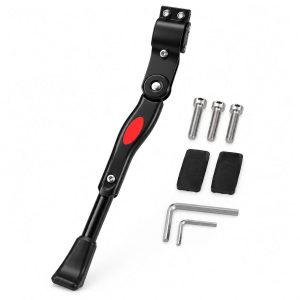
The listed detail worth testing on delivery is Three stainless hex bolts and two rubber pads grip the frame. A discrepancy here is easier to resolve inside the return window.
Compare 33-38cm against the gap you measured earlier. If the two numbers are close, leave yourself margin for the rack.
| Specification | Listed value | Why it matters |
|---|---|---|
| 33-38cm | The leg extends from 33cm to 38cm to suit different wheel sizes. | Check against your bike and where you park |
| aluminium alloy | Listed fitments cover 20, 22, 24, 26 and 27.5in wheels and 451/650C road wheels. | Check against your bike and where you park |
| hex bolts | Three stainless hex bolts and two rubber pads grip the frame. | Check against your bike and where you park |
| 27.5in | The body is aluminium alloy with a baked paint finish. | Check against your bike and where you park |
More modes on a light are not automatically better if the rider has to cycle through all of them to switch the unit off.
A longer cable adds reach but also adds something to carry. The trade-off is decided by the rack, not by the catalogue.
Related products:
- View Adjustable Alloy Kickstand 33-38cm — product details
- View Heavy Duty U-Lock 19mm with Cable — product details
What buyers actually report
Review UGC-00158 says “muy practico y facil de llevar recomendable y muy buena construcción no me llego con fallas o dañado como algunos reportan” We quote it verbatim because paraphrasing would quietly change the symptom.
“muy practico y facil de llevar recomendable y muy buena construcción no me llego con fallas o dañado como algunos reportan” — UGC-00158, 5 star, Amazon US, 2026-05-21
What is missing here is a measurement. That is the first thing to add when you check your own setup.
“I am re-reviewing this after my initial 3-star review I have changed my opinion and I’ll now rate it four stars.” — UGC-00179, 4 star, Amazon US, 2026-04-06
Notice that the report names a symptom and a timeframe, but not a cause. That is the honest starting point for a diagnosis.
“It’s a very good, sturdy lock that would probably take a Thief a while to cut through.” — UGC-00205, 4 star, Amazon US, 2025-12-17
Read this as one buyer’s observation. It is evidence of a question worth checking, not evidence of a defect rate.
This page uses the 983-review corpus qualitatively; the exact phrase “centre mount vs rear mount kickstand” is not quantified because a phrase match would not be a reliable measure of how common the problem is.
A dated specification is more useful than a confident adjective. The first can be checked; the second cannot.
The vocabulary buyers use
In the 573-paragraph corpus of real cycling articles behind this site, the “user pain points” word group appears most often in specification, comparison and problem paragraphs. These terms are counted from actual article text, not suggested by a keyword tool; none of them represents a search-volume estimate.
| Term observed | Occurrences in this paragraph role | Distinct articles |
|---|---|---|
| heavy | 2 | 2 |
| lost | 2 | 2 |
| awkward | 2 | 2 |
| lost | 2 | 2 |
| heavy-duty | 2 | 2 |
| break | 2 | 2 |
Treat this as vocabulary evidence only. It tells you how the topic is written about, not how often it is searched, and it carries no ranking or traffic estimate.
Checks to run before you commit
- Charge or cycle the device fully once, then test it again after a week. Several buyer reports describe a fault appearing in that interval.
- Keep a short written record: the date, the measured dimension, and what happened on the tenth cycle. It makes a return conversation simple.
- Start by measuring the gap the device must span, including the rack. Then check the valve type, wheel size or shackle clearance that applies to your bike.
Australian conditions and everyday scenarios
In an apartment bike store with no wall rail, the device is handled twice a day. Small parts such as straps, caps and keys see more cycles than the main body.
With a campus rack between lectures, the same lock may be used by more than one rider. A shared code or a shared key changes the risk profile.
A cheaper option is not automatically a worse one if the parking situation is low-risk. Paying for resistance you will never need is its own kind of waste.
Related checks on this site
- specification and availability for adjustable alloy kickstand 33-38cm
- park it before you lock it — in-context link
- what 983 competitor reviews say about failure patterns
- how we describe lock capability without claiming a rating
- What Adjustable Kickstand 24 to 29 Inch Actually Tells You About Fit
- What Kickstand for Kids Bike 20 Inch Actually Tells You About Fit
- How to Get Adjustable Bike Kickstand 26 Inch Right the First Time
- Floor Pump with Gauge for a Loaded Bike: A Problem-First Guide — S-B guide
Frequently asked questions
Does the listing specification match what I should measure on the bike?
Measure it on your own bike, with the rack you actually use. Published dimensions are a starting point, not a substitute for that check.
What is the difference between a fit problem and a faulty part?
Keep the proof of purchase and test every function inside the return window. Several reports in our sample describe a fault found just after that window closed.
This page reports what a listing states and what buyers wrote. It does not add an independent measurement of either.
How should I maintain the mechanism in Australian conditions?
Measure it on the bike with the rack you use, and keep a little margin. A dimension that only just fits will not fit on a different rack.
How do I know which size or length I need?
Test every function on the day it arrives and again a week later, while the return window is still open.
Sources, method and last verified
- Review corpus: 983 competitor reviews supplied for this site; quoted excerpts are verbatim and identified by review id. See the method page.
- Reddit (via road.cc), Guess I’ll get the bus then; Bike stolen right in front of me in gated development — https://road.cc/content/news/cycling-live-blog-16-may-2025-314019
- BikeForums.net forum, are kryptonite locks good?; Do you have an indestructible lock?; What lock to get?; Krypto — https://www.bikeforums.net/general-cycling-discussion/84156-kryptonite-locks-good.html
- Instagram caption template library (SportsFoundation), 183+ Cycling Captions for Instagram: Funny, Short and Road Rides — https://sportsfoundation.org/cycling-instagram-captions/
- Product specifications: retailer listing transcription, checked 2026-11-04 (AEDT).
Specifications on this page are transcribed from the retailer listing as at 2026-11-04 (AEDT). They are not the result of independent testing.
Review excerpts are quoted verbatim from a corpus of competitor reviews supplied for this site. They describe third-party products, not our own.
We do not claim any third-party security rating, certification or endorsement for our own products.
Last verified: 2026-11-04 (AEDT). Search volume, keyword difficulty and AI citation rate: not available (TBD).
The short version
Use the tables, take the measurements, and keep the dated record. That is the whole method; there is no hidden ranking behind it.
Related products:
- View Adjustable Alloy Kickstand 33-38cm — product details
- View Heavy Duty U-Lock 19mm with Cable — product details



Have a question?