

Short answer
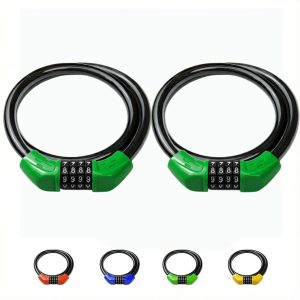
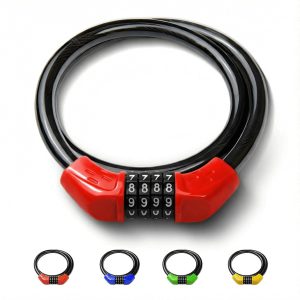
This page addresses the question “bike lock for scooter” for Australian riders. It is not a product ranking; it is a check of fit, specification and failure mode for a 103cm four-digit cable lock. It draws on 983 competitor reviews collected for this site and contains no independent bench testing, no security rating and no unverified rule or penalty figure.
Last verified: 2026-11-04 (AEDT). Specifications are listing transcriptions, not test results. Search volume and ranking data are not available for this page.
Key facts you can check
| Field | What we can state | How to check it |
|---|---|---|
| Subject | 4-Digit Combination Cable Lock 103cm | Measure on your own bike |
| First check | A 103cm braided steel cable sits inside a protective sleeve. | Listing specification, as at 2026-11-04 (AEDT) |
| Key measurable terms | 103cm, braided steel, four-digit, resettable | Tape measure, scales, or valve/wheel check |
| Typical situation | short stops and low-value bikes in low-risk areas | Your own parking time and location |
| Review sample | 983 competitor reviews | Corpus text match, not a defect rate |
| Independent testing | None on this page | We do not run a test programme |
Any field we could not verify is marked as unverified rather than filled with an estimate.
What problem are you actually solving
Riders ask about bike lock for scooter as if there is one correct answer. In practice the right choice changes with how long the bike is left alone.
Specifications are written for a test bench or a listing page. Your bike, your rack and your commute are not the test bench.
A reported fault is a description, not a diagnosis. The same symptom can come from installation, wear or an unsuitable specification.
Here, fit means the measurable relationship between a part, a frame and a fixed object. It is not a matter of brand preference.
The three failure modes worth checking first
1. Fit and alignment
Note the valve or wheel size on your bike, then compare it with the compatibility line. Do this before the packaging is discarded.
The next section separates the measurable specification from the surrounding claims.
2. Mechanism and reset
Charge or cycle the device fully once, then test it again after a week. Several buyer reports describe a fault appearing in that interval.
Once the fit is settled, the remaining uncertainty is about behaviour over time rather than dimensions.
3. Wear after several weeks
Keep a short written record: the date, the measured dimension, and what happened on the tenth cycle. It makes a return conversation simple.
The distinction is worth one more step, because it changes what you should test on delivery.
Buying the strongest item and leaving it at home is a common outcome. Portability belongs in the decision, not as an afterthought.
Specifications that matter
Specifications worth checking are 103cm, braided steel and four-digit. Anything else on the box should be treated as a claim until you have measured it.
The difference between two similar products is often one dimension rather than one material. A 103cm braided steel cable sits inside a protective sleeve.
Read the dimensions before the adjectives. 103cm and braided steel can be measured; claims about overall strength usually cannot.
| Specification | Listed value | Why it matters |
|---|---|---|
| 103cm | A 103cm braided steel cable sits inside a protective sleeve. | Check against your bike and where you park |
| braided steel | The four-digit code is resettable, so no key needs to be carried. | Check against your bike and where you park |
| four-digit | The cable also suits scooters, helmets, gates and similar gear. | Check against your bike and where you park |
More modes on a light are not automatically better if the rider has to cycle through all of them to switch the unit off.
A longer cable adds reach but also adds something to carry. The trade-off is decided by the rack, not by the catalogue.
Related products:
- 4-Digit Combination Cable Lock 103cm — product page & restock status
- View 5-Digit Resettable Cable Lock 120cm — product details
What buyers actually report
Review UGC-00483 says “I just got this lock for about 3 weeks and used it it has been good but somehow someone was able to pull the lock and unlocked it” We quote it verbatim because paraphrasing would quietly change the symptom.
“I just got this lock for about 3 weeks and used it it has been good but somehow someone was able to pull the lock and unlocked it” — UGC-00483, 1 star, Amazon AU, 2024-05-16
What is missing here is a measurement. That is the first thing to add when you check your own setup.
“The bike lock is too short, I can’t even lock the wheel and the bike together” — UGC-00518, 1 star, Amazon AU, 2023-04-29
Notice that the report names a symptom and a timeframe, but not a cause. That is the honest starting point for a diagnosis.
“Functioned very well at first but one of the units failed to work after a heavy rainfall and had to be replaced as it stopped working.” — UGC-00417, 3 star, Amazon AU, 2026-08-18
Read this as one buyer’s observation. It is evidence of a question worth checking, not evidence of a defect rate.
This page uses the 983-review corpus qualitatively; the exact phrase “bike lock for scooter” is not quantified because a phrase match would not be a reliable measure of how common the problem is.
A dated specification is more useful than a confident adjective. The first can be checked; the second cannot.
The vocabulary buyers use
In the 573-paragraph corpus of real cycling articles behind this site, the “commerce & conversion” word group appears most often in specification, comparison and problem paragraphs. These terms are counted from actual article text, not suggested by a keyword tool; none of them represents a search-volume estimate.
| Term observed | Occurrences in this paragraph role | Distinct articles |
|---|---|---|
| buy | 2 | 2 |
| amazon associate | 2 | 2 |
| reviews | 2 | 2 |
| recommend | 2 | 1 |
| available | 2 | 2 |
| features | 2 | 2 |
Treat this as vocabulary evidence only. It tells you how the topic is written about, not how often it is searched, and it carries no ranking or traffic estimate.
Checks to run before you commit
- Charge or cycle the device fully once, then test it again after a week. Several buyer reports describe a fault appearing in that interval.
- Keep a short written record: the date, the measured dimension, and what happened on the tenth cycle. It makes a return conversation simple.
- Start by measuring the gap the device must span, including the rack. Then check the valve type, wheel size or shackle clearance that applies to your bike.
Australian conditions and everyday scenarios
In an apartment bike store with no wall rail, the device is handled twice a day. Small parts such as straps, caps and keys see more cycles than the main body.
With a campus rack between lectures, the same lock may be used by more than one rider. A shared code or a shared key changes the risk profile.
A cheaper option is not automatically a worse one if the parking situation is low-risk. Paying for resistance you will never need is its own kind of waste.
Related checks on this site
- specification and availability for 4-digit combination cable lock 103cm
- 4-digit vs 5-digit resettable — variant comparison
- what 983 competitor reviews say about failure patterns
- how we describe lock capability without claiming a rating
- Lock Mini Haven’t: A Problem-First Guide
- How to Get Secure Bike Right the First Time
- Bike Tyre Pressure Chart Australia: A Problem-First Guide — S-A guide
- Heavy Duty Bike Lock: A Problem-First Guide — S-B guide
Frequently asked questions
Does the listing specification match what I should measure on the bike?
No. A specification describes a design limit, not a guarantee of performance in a particular situation or over a particular period.
What is the difference between a fit problem and a faulty part?
Measure it on your own bike, with the rack you actually use. Published dimensions are a starting point, not a substitute for that check.
This page does not include bench testing, cut testing or a laboratory rating. Where a claim cannot be checked from the listing, we say so.
How should I maintain the mechanism in Australian conditions?
Keep the proof of purchase and test every function inside the return window. Several reports in our sample describe a fault found just after that window closed.
How do I know which size or length I need?
Measure it on the bike with the rack you use, and keep a little margin. A dimension that only just fits will not fit on a different rack.
Sources, method and last verified
- Review corpus: 983 competitor reviews supplied for this site; quoted excerpts are verbatim and identified by review id. See the method page.
- ROCKBROS US official blog, 7 Practical Cycling Gifts Every Rider Will Actually Use — http://rockbrosbike.us/blogs/cycling-gear-guides-buying-advice-rockbros/7-practical-cycling-gifts-every-rider-will-actually-use
- Finder Shopping Australia buying guide, Best bike locks in Australia 2026 — https://findershopping.com.au/best-bike-locks
- NestPath Australia Amazon AU buying guide, The Best Bike Locks in Australia for 2026 — https://nestpath.com.au/homeowner-hub/best-bike-lock-australia
- Product specifications: retailer listing transcription, checked 2026-11-04 (AEDT).
Specifications on this page are transcribed from the retailer listing as at 2026-11-04 (AEDT). They are not the result of independent testing.
Review excerpts are quoted verbatim from a corpus of competitor reviews supplied for this site. They describe third-party products, not our own.
We do not claim any third-party security rating, certification or endorsement for our own products.
Last verified: 2026-11-04 (AEDT). Search volume, keyword difficulty and AI citation rate: not available (TBD).
The short version
Use the tables, take the measurements, and keep the dated record. That is the whole method; there is no hidden ranking behind it.
Related products:
- 4-Digit Combination Cable Lock 103cm — product page & restock status
- View 5-Digit Resettable Cable Lock 120cm — product details



Have a question?